

How NoPlayWedge Compares to Hitch Receiver Clamps & Pins


The trailer hitch world is full of products that promise to stop rattle.
Some clamp, some pin, some squeeze, some wedge, and some look like they were invented in a hurry at the back of a welding shop - yet somehow made it to e-commerce.
Which is fine. Not every product has to win a design award. But if you are trying to fix hitch play for real, the important question is not what the product is called.
It is this:
How is it actually trying to solve the problem?
Because all anti-rattle products are not doing the same thing, even when they claim the same result.
Start with the problem, not the product
Before comparing solutions, it helps to define the actual issue. The problem is play between the drawbar and the receiver.
That play creates:
clunk
rattle
movement
long-term wear
a towing feel that is looser than it should be
So any product claiming to “stop rattle” really needs to be judged by one standard:
How effectively does it reduce movement at the hitch connection?
That is the whole game.
What hitch pins do well
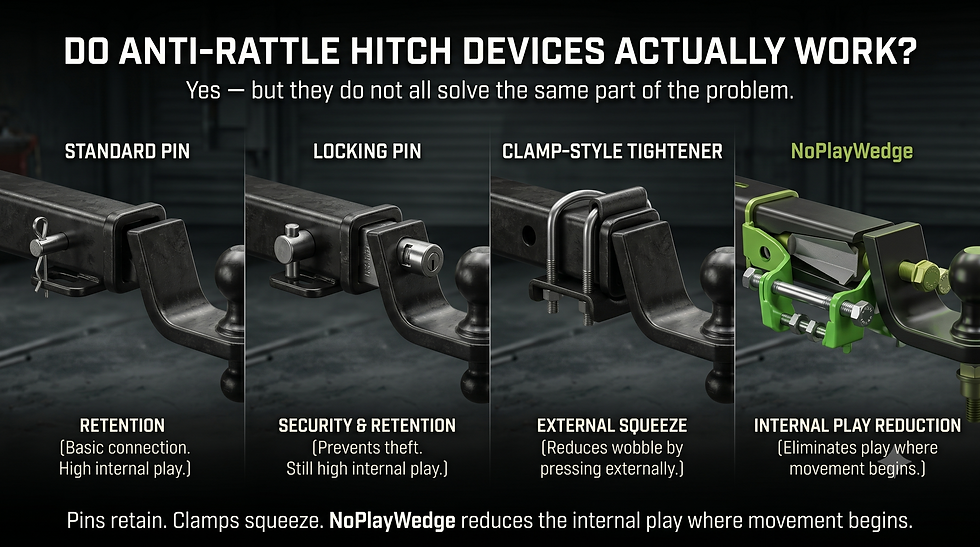
A standard hitch pin has one primary job: keep the insert from sliding out.
That is important. Essential, actually. But it does not mean the setup will be tight.
A pin is not really a precision fit solution - it's a retention method. If there is clearance inside the receiver, the insert can still move within that clearance while remaining fully pinned. That is why a setup can be completely “secured” and still clunk like a shopping cart full of tools.
Bottom line on pins:
They're good for retention
Though not enough by themselves to eliminate play
What locking pins do well
Locking pins add theft deterrence and convenience. Nobody wants their ball mount walking away in a parking lot. But from an anti-rattle perspective, a locking pin is still mostly a pin. Sometimes it helps a little depending on fit and design. Sometimes not much. It is still not fundamentally changing the geometry inside the receiver the way a true anti-play solution should.
Bottom line on locking pins:
They're helpful for security
They're limited as a true anti-rattle fix unless paired with something else
What clamp-style anti-rattle devices do
Clamp-style devices usually apply external pressure to reduce movement. Some tighten around the receiver and drawbar from the outside. Some use brackets, U-bolts, plates, or collars. Some work reasonably well in the right situation. Clamp strength is obvious: they can force things tighter. Their weakness is also obvious: they are often working around the fit rather than solving it directly at the internal gap.
Sometimes that's enough, but sometimes it is awkward, and more than often than not, it also adds bulk.
Sometimes installation is less elegant than advertised. Sometimes the result feels more like brute force than precision. And this is where philosophy starts to matter.
Do you want a product that compresses the outside of the system...or one that addresses the actual gap where the movement begins?
Bottom line on clamps:
They can help reduce rattle
They're often more external, more hardware-heavy
They may feel less elegant depending on the setup
What NoPlayWedge is doing differently
NoPlayWedge takes a more mechanical, fit-focused approach. Instead of just squeezing from the outside or relying on the pin alone, it is designed to fill the gap between the drawbar and receiver with a wedge-based system. That matters because the gap is where the movement starts.
That means the most important logic is not: “hold everything harder.” It is: “reduce the unwanted space that allows movement in the first place.”
That is a very different way of thinking about the problem. And in towing, the way you think about the problem usually determines whether the solution feels temporary... or permanent and right.
Why that difference matters in the real world
Trailer enthusiasts know this already, even if they have never put it into words:
The best mechanical solutions usually feel obvious in hindsight.
Not flashy or overcomplicated, just correct.
That is the appeal of a wedge-based fitment solution when it is done well. You are not just adding hardware to the outside of the problem. You are improving the connection itself.
That can mean:
less clunk
less play
a quieter towing feel
more confidence under load
less wear over time
And that is exactly what most people are actually after. Not a gimmick or a hack - just a better connection.
So which is better?
That depends on what you want. If you just want to keep the insert from disappearing, a pin does that. If you want added security, a locking pin can help. If you want an external pressure solution and do not mind the hardware approach, a clamp may be fine.
But if your goal is to reduce movement more intelligently and create a tighter-feeling towing setup, NoPlayWedge makes a strong case because it is focused on the real point of failure: the fit between the receiver and the insert. That is the key distinction.
The real question to ask before buying anything
Do not ask only: “Will this stop the noise?”
Ask:
How does it work?
Where is it applying force?
Is it addressing the gap or just containing the symptoms?
Will it still feel like a clean solution after repeated use?
Those questions tell you a lot. Because in towing, just like in racing, construction, fabrication, and every other world where mechanics matter, the difference between “good enough” and “right” is usually hiding in the fit.
Final thought
There is no shortage of products in the towing hitch world that promise to quiet things down. But the most useful evaluation is not comparing marketing copy to other marketing copy. It is examining the engineering approaches to solving the real problem.
Pins retain. Clamps squeeze. NoPlayWedge reduces the play where the problem begins.
That is why the engineering comparison matters.
And for people who tow enough to care how the setup actually feels, that difference is not small. It's the whole point!


Comments