

Why Does My Trailer Hitch Clunk?

There are few sounds in towing more irritating than the infamous hitch clunk.
Not because it is loud - though sometimes it is, and not because it means disaster is imminent because usually it isn't. It's because your hitch sounds like something's loose. Well, we have news for you, something IS loose.
Every time you hear it, your brain says the same thing:
That shouldn't be happening.
And that instinct is right.
A lot of people normalize hitch clunk the same way people normalize bad brakes on a shopping cart. They just accept it. “That’s towing.” “That’s just how receivers are.” “All ball mounts move around a little.”
True enough. But that does not mean it can't be fixed with some good engineering.
What is actually making the noise?
The clunk is usually not some mystery deep inside the truck. It is almost always the result of play between the drawbar and the receiver.

A receiver hitch is designed to accept a removable insert. That insert has to slide in and out which means it cannot be a perfect interference fit. There has to be tolerance, a little room, and a little clearance to function properly.
That clearance is where the trouble starts.
When the vehicle accelerates, brakes, dips, turns, or loads and unloads, that insert can shift inside the receiver. Even tiny movement, repeated over and over, becomes audible.
Metal taps. Slack shifts. Load transfers. and then the old familiar "Clunk!"
And once you hear it, you can’t un-hear it.
Clunk is not just sound. It's movement.
This is the important part.
People tend to think the noise is the problem, well, it isn't. The noise is the announcement. The actual problem is movement.
That movement can lead to:
a less stable towing feel
more wear between metal surfaces
more distraction behind the wheel
more irritation every time you stop, start, or hit uneven pavement
In other words, the sound is the symptom, and the play is the disease.
Why does it seem worse on some setups than others?
Because not all towing setups are created equal. A light bike rack on smooth roads may barely reveal any looseness. A heavier drawbar, cargo load, boat trailer, or travel trailer on uneven pavement will expose every weak point in the connection. Add miles, vibration, and repetition, and that tiny bit of slack starts behaving like a permanent bad habit.
Heavy-duty trucks can be their own category of fun here too. Bigger receivers, bigger components, bigger loads, etc. means bigger opportunity for movement if the fit is not tight. Which is why some people tow for years and shrug. And others hear five minutes of hitch clunk and immediately start hunting for a fix.
Isn’t the hitch pin supposed to solve that?
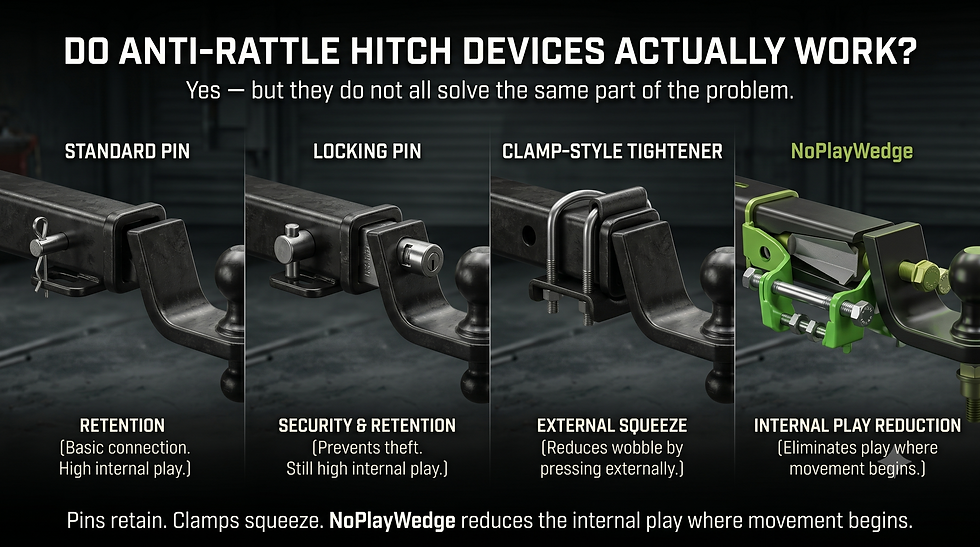
No. Not really. The hitch pin keeps the insert from sliding out. That is its job. It's a retention device. It is not designed to eliminate all movement inside the receiver tube.
That's an important distinction.
A pinned connection can still rattle, shift, and knock around under load. The pin is doing its job; it's just not solving the whole problem.
What about clamps, pins, and anti-rattle gadgets?
Some of them help, and some only help a little. Some help until they don’t, and some create pressure from the outside rather than solving the fit from the inside. Some even work better on certain setups than others.
The real question is simple:
Are you actually reducing the play at the source, or are you just managing the symptoms?
That is where better solutions separate themselves from accessory clutter.
The deeper issue nobody talks about enough: wear
Here is where the clunk gets more expensive than annoying.
Repeated movement between the receiver and the insert can create wear over time. Not overnight, and not in dramatic movie fashion. Just the slow, familiar way mechanical systems wear down when movement and load keep showing up in the same place.
A little looseness becomes more looseness. A little tapping becomes more tapping. A little wear becomes more slop. Again, this is why the sound matters. It is feedback.
Your towing setup is telling you something.
So what is the actual fix?
The best fix is not pretending the clearance does not exist. It's addressing it intelligently. That means reducing the unwanted movement between the insert and the receiver, creating a tighter connection, and giving the whole setup a more stable feel under real towing conditions.
That is exactly the thinking behind NoPlayWedge.
Instead of accepting hitch clunk as “just part of towing,” the better approach is to treat it like what it is: a mechanical problem worth solving. Not cosmetically. Mechanically.
Because towing always feels better when the connection feels right. Tighter, quieter, more planted, and a lot less distracting. Which, honestly, is what most of us wanted in the first place.
Final thought
Hitch clunk is one of those things people live with until they finally decide they are tired of living with it. Then they realize the real issue was never the noise alone. It was the slack, the play, and the sense that the system was just a little looser than it should be.
And once you feel the difference a tighter towing setup makes, it gets hard to go back.


Comments