

2" vs 2.5" Receiver Hitch: What’s the Difference, and Why It Matters


A lot of towing confusion starts the same way: you know you have a truck, you know you have a hitch, and you generally know you need the thing that fits the hitch. And then the trouble begins.
Because once you move beyond “yeah, it’s a receiver hitch,” the next question matters a lot more than people expect:
Is it a 2-inch receiver or a 2.5-inch receiver?
That sounds like a small detail, but it isn’t.
In towing, small differences become big differences fast. Especially when the whole point is getting a tighter, quieter, more confidence-inspiring connection. So let’s break it down cleanly.
First: what are we actually talking about?
When people say 2-inch receiver or 2.5-inch receiver, they mean the inside opening of the receiver tube. That opening determines what can slide in, what fits properly, and what towing hardware is compatible with the setup.
It's not:
the outside of the receiver
the size of the hitch pin
the size of the ball
the size of the truck’s ego
It is the inside square opening. That is the number that matters.
What is a 2-inch receiver?
A 2-inch receiver is the most common size on many:
half-ton trucks
midsize trucks
SUVs
lighter-duty towing setups
It is popular because it covers a huge range of common towing needs without stepping into heavy-duty hardware territory.
If you tow:
utility trailers
small to medium enclosed trailers
travel trailers
cargo carriers
bike racks
boat trailers on common consumer setups
…there is a good chance you are dealing with a 2-inch receiver.
Not always. But often enough that people assume it is universal.
It isn’t.
What is a 2.5-inch receiver?
A 2.5-inch receiver is more common on:
heavy-duty trucks
3/4-ton and 1-ton pickups
certain higher-capacity towing packages
setups built for more serious loads and heavier-duty hardware
This is where towing starts to feel a little less “weekend convenience” and a little more “actual work.” A bigger receiver means bigger components, more towing capacity, and more opportunity for movement if the fit is not dialed in correctly.
A lot of people first discover they have a 2.5-inch receiver only after they try to use something built for a 2-inch setup and realize the fit is… optimistic.
So what is the actual difference?
At the most basic level, the difference is simple:
A 2-inch receiver has a smaller inside opening
A 2.5-inch receiver has a larger inside opening
That means the hardware meant for one will not automatically fit the other correctly. And this matters for more than basic compatibility.
Because once you care about:
reducing hitch play
eliminating clunk
creating a tighter towing feel
limiting unnecessary wear
…the fit between the insert and the receiver becomes a very big deal.
That is where “close enough” becomes expensive.
Why people get confused
Because towing setups are full of qualifiers.
The truck might be:
the same model, different trim
the same family, different tow package
factory-equipped one year, changed the next
fitted with an aftermarket hitch
running an insert, reducer, or sleeve
So people say things like:
“I have a heavy-duty truck, so it must be 2.5”
“It’s a half-ton, so it must be 2”
“My buddy’s truck is the same and his is…”
“I thought all of these used the same receiver”
Maybe. Maybe not. That's why measuring beats assuming. Every time.
Does bigger mean better?
Not in the abstract. A 2.5-inch receiver is not “better” than a 2-inch receiver in the same way a hammer is not better than a wrench. It just belongs to a different application envelope.
The real question is not: Which one is better? It is:Which one do you actually have, and what solution fits it correctly?
That's the question that will save you time, returns, and irritation.
Where this matters most: movement and fit
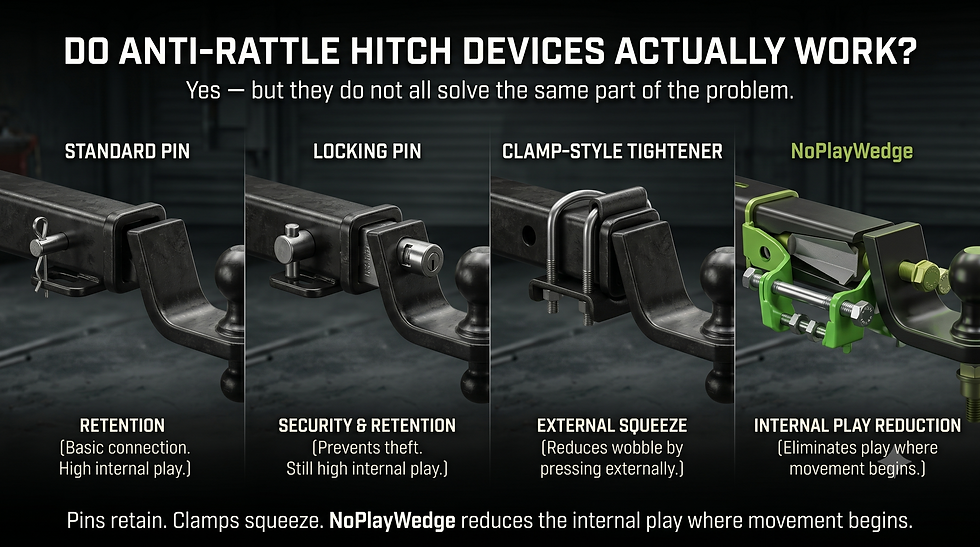
This is where NoPlayWedge enters the conversation. Because the whole point of a better anti-rattle solution is not simply owning hitch hardware. It's reducing unwanted movement inside the towing connection.
That means the receiver size is not just a catalog detail. It is part of the mechanical reality of the system. A solution designed around the wrong size receiver is not going to give you the fit, stability, or quiet towing feel you are after. And if you are dealing with a larger heavy-duty receiver, the wrong assumption can leave you wondering why the setup still feels loose.
So how do you know which one you have?
Simple: Measure the inside opening of the receiver tube. That is it.
If it measures:
about 2 inches → you have a 2-inch receiver
about 2.5 inches → you have a 2.5-inch receiver
about 3 inches → congratulations, now you are in another category entirely
Do not measure the outside. Do not guess based on truck reputation. Do not trust “pretty sure.” Measure it once, and buy correctly.
A quick rule of thumb
In general:
Many half-ton and midsize trucks are 2-inch
Many heavy-duty trucks are 2.5-inch
Some heavier configurations go to 3-inch
That is useful as a starting point. It is not the final answer. Your actual hitch is the final answer.
Why this matters for anti-rattle solutions
Because anti-rattle performance is really about fit. The connection feels tighter when the right parts are working in the right dimensions. That is true in towing, racing, fabrication, machining, and pretty much every other world where mechanical slop has consequences.
If you want:
less clunk
less play
less wear
a quieter towing feel
more confidence behind the wheel
…you start by choosing the solution that matches the receiver correctly.
Not approximately. Correctly.
Final thought
The difference between a 2-inch and 2.5-inch receiver sounds like the kind of thing people should not need explained. Until they do. And in towing, the details that seem boring are usually the ones that matter most.
Because once the hitch fit is right, everything downstream gets better:
the install
the stability
the feel
the confidence
the absence of that annoying clunk that had no business being there in the first place
So before you buy, before you guess, before you decide you “probably know” what your truck has: Measure it.
That one small step makes the rest of the decision a whole lot smarter.


Comments