

Do Anti-Rattle Hitch Devices Actually Work?

This is one of those questions people ask after they’ve heard the hitch clunk one too many times and finally hit a point somewhere between curiosity and annoyance.
The question is fair.
Because the towing world is full of products that promise to:
stop rattle
eliminate movement
tighten the connection
make everything feel secure, silent, and somehow vaguely heroic
Some of them work. Some sort of work.Some work just enough to make you think you solved the problem until the next road, ramp, bump, or braking cycle reminds you otherwise.
So let’s answer the question directly:
Yes, anti-rattle hitch devices can work. But not all of them work the same way, and not all of them solve the same part of the problem. That’s the part people usually miss.
First, what problem are these devices trying to solve?
The issue is not magic; it’s mechanics. A receiver hitch is built to accept an insert. That insert, whether it’s a drawbar, ball mount, rack mount, or accessory shank, has to slide into the receiver. Which means there is clearance: a little space, room, and tolerance.
That tolerance is where the movement starts.
Under load, braking, acceleration, turns, dips, driveway entrances, potholes, and all the other wonderful things the real world throws at towing setups, the insert can shift inside the receiver.
That movement creates:
clunk
rattle
looseness
a less stable towing feel
wear over time
So yes, anti-rattle devices are trying to solve a real problem.
The better question is:
How are they trying to solve it?
Not all “anti-rattle” devices do the same job
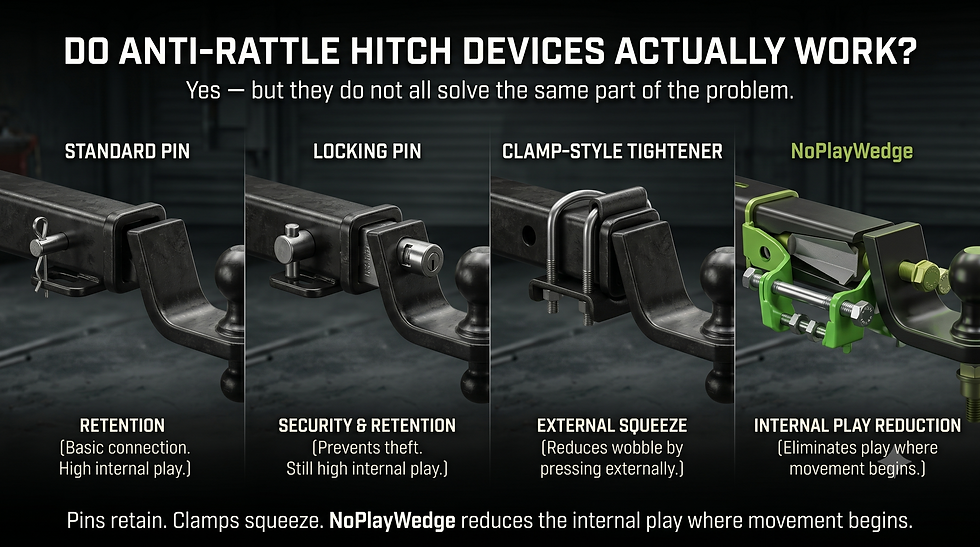
This is where the category gets muddy. A standard hitch pin is not really an anti-rattle device. It is a retention device. Its job is to keep the insert from sliding out. That matters a lot, but it does not mean the insert can’t still move inside the receiver.
A locking hitch pin adds security, which is useful. But again, security is not the same as reducing play.
Clamp-style devices usually apply force from the outside. They can help, and sometimes quite a bit. But they are doing it by externally squeezing the system, which is different from improving the fit at the source.
And then there are wedge-based approaches, which try to reduce the gap where the movement begins. These are not trivial differences. They're the whole story.
So… do they work?
Yes. But the honest answer is: Some devices work better for retention. Some work better for security. Some work better for reducing movement.
And the more you care about:
actual towing feel
long-term durability
cleaner mechanical fit
less clunk over time
…the more that distinction matters.
Because if the product you bought is excellent at one job but your problem is actually another job, you can walk away disappointed even though the product technically did what it was designed to do. That happens all the time.
What does “working” even mean?
For one person, “it works” means:
My bike rack doesn’t wiggle as much.
For someone towing a trailer, “it works” might mean:
The clunk is gone and the whole setup feels tighter.
For someone more mechanically sensitive, “it works” means:
The connection feels more planted, more controlled, and less sloppy under real load.
Those are different standards.
And if you are the kind of person who notices how things feel, not just whether they technically remain attached to the truck, then you already know that not all fixes are equal.
The real issue is whether the device addresses the source of movement
That’s the dividing line.
If a product is mostly:
retaining the insert,
locking the insert,
or squeezing the setup from the outside,
Then it may help, but it may not fully solve the looseness where it begins. If a product is designed to reduce the internal gap that allows movement in the first place, that is a different kind of solution. That’s why the comparison matters.
Because when people say, “I tried an anti-rattle device and it didn’t really solve it,” they often aren’t saying anti-rattle products don’t work. They’re saying: the one I used didn’t solve the problem the way I needed it solved. That’s a very different thing.
Why are some people disappointed even after buying one?
Usually one of four reasons:
1. Wrong product for the real problem
They needed a tighter fit solution. They bought a retention or security product.
2. Wrong fitment
They guessed on receiver size or setup and bought something that wasn’t really matched to the hitch.
3. Wrong expectations
They wanted a dramatic improvement, but bought something that only helps marginally.
4. The hitch system already has enough wear that a light-duty fix won’t feel transformative
This is real, too. If the setup has been moving and wearing for a long time, expectations need to be grounded in the actual mechanical condition.
Where NoPlayWedge fits into this conversation
NoPlayWedge was built around a different question. Not: How do we hold everything harder? But: How do we reduce the unwanted space that lets the insert move in the first place?
That’s an engineering question, and it leads to a different type of answer.
The idea is to improve the mechanical fit, reduce movement at the source, and create a tighter-feeling towing connection instead of just adding more hardware around the outside of the problem.
That is why people who care about:
clunk
play
towing feel
wear
confidence under load...
...tend to notice the difference.
Because what they’re reacting to isn’t just silence. It’s the connection that feels more correct.
What should you ask before buying any anti-rattle solution?
Here’s the real checklist:
What is this product actually designed to do?
Is it retaining the insert, securing it, squeezing it, or reducing the internal play?
Does it fit my receiver size and setup correctly?
Am I solving the actual source of movement, or just trying to quiet the symptom?
Will this still feel like a smart solution after repeated towing use?
Those questions will tell you more than most product pages.
Final thought
So, do anti-rattle hitch devices actually work? Yes. They can.
But the more honest answer is: they work differently, for different purposes, with different levels of effectiveness.
And if your goal is not just to “do something” about the rattle, but to create a tighter, quieter, more confidence-inspiring towing connection, then the design approach matters a lot. Because in the end, the real question is not whether a product belongs to the anti-rattle category. It’s whether it actually improves the connection in the way you care about.
And for people who tow enough to notice the difference, that is where everything starts to separate.... pun intended!


Comments